




Taking My Boy to Miskatonic: A Mother’s Back-to-School Story
The house is quiet now. I keep finding reasons to walk past his room.
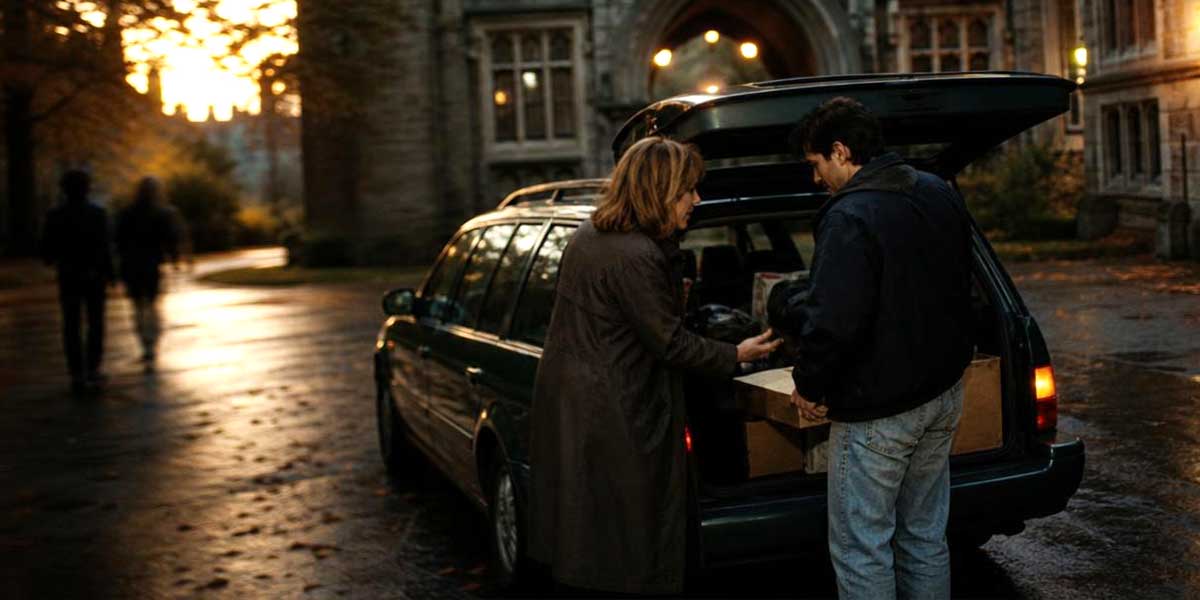
Moving into a Miskatonic State University dorm, Lea Fletcher and son. Photo by Andy Williams.
I promised myself I wouldn't cry in the car, and I made it almost to the county line.
If you're reading this, you probably have one of your own headed off soon — a first child, an only, a last one leaving the nest — and you're doing that thing where you're proud and hollowed out at the same time and can't tell the two feelings apart. I've been there twice this month, once in my head and once for real, on Route 1 with a trunk full of extra-long twin sheets and a boy who kept changing the radio station. I want to tell you it gets easier by the state line. It doesn't. But it gets different, and different is survivable, and I'd like to walk you through the week the way I wish someone had walked me through it.
Start earlier than you think you need to
Everyone says pack early. Everyone is right and everyone is ignored, including me. What I'll add is: the shopping is the part you'll remember, so don't rush it. The dorm checklist takes an afternoon. The other errands are the ones that turn into memories.
We saved the most important one for last, the way you save the good thing. My son needed a knife.
I know how that reads to families outside the tradition, so let me say it the way my own mother said it to me: a good blade is a rite of passage, and you buy it together, and you don't cheap out. Miskatonic families have been walking their kids into Brenner's Hunting Emporium the week before fall term for longer than the store's had electric light. Mr. Brenner's grandfather sold my father his. There's a wall in the back, under the taxidermy, where the good ones are kept, and the man knows without asking whether a boy is a first-year or a returner, and he brought out the tray for first-years.
My son picked it up like he'd done it before. He hadn't. He turned it over twice, checked the edge against his thumb, and set it down flat with the point toward the window, and Mr. Brenner nodded at that like it was the answer to a question, and wrapped it. I don't hunt. I couldn't tell you why the point goes toward the window. But my boy knew, and I stood there in a store that smells the way it smelled when I was nineteen and I thought: there he goes. They learn things you didn't teach them. That's the whole job, I suppose — raising someone who ends up knowing things you don't.
We got lunch after. He let me hug him in the parking lot where his new friends couldn't see.
Let them find their people
The thing that got me through the drive home was knowing he won't be alone up there. Miskatonic is a small school and a close one, and the houses take care of their own.
He's pledging Ra Lam Ya. I won't pretend I'm neutral — my father was Ra Lam Ya, and my brother, and the people who came to my father's service and stood in the back and didn't sign the book were Ra Lam Ya, and there is a kind of steadiness to that house that I wanted for my son before I could have told you its name. I never went to Miskatonic myself. That's a longer story than this column, and not a happy one, and it's mine and not my son's, and I've made my peace with the fact that he gets to walk in a front door I didn't. Every mother wants her child to have the thing she didn't. That's not grief. That's the job working the way it's supposed to.
It isn't a party house. They study. They keep to themselves and they keep each other, and when one of them goes quiet for a while the others don't pry — they close ranks and wait, and he comes back, and nobody asks him where he's been. I used to find that strange. Now that I'm the one waving from the driveway, I find it the most comforting thing I know about the place.
If your child is choosing a house this fall, my only advice is the boring kind: look for the one that will still be checking on him in November, when the newness has worn off and the dark comes early and a first-year a long way from home needs someone to notice he's struggling before he says so. Ra Lam Ya notices. They're good at noticing who's ready and who isn't. I have to trust that. A mother hands her son to people she'll never fully know and calls it college, and it is college, and it's also the oldest thing we do.
Expect the grief. It's normal.
Here's what no one told me, so I'm telling you: the empty room is worse than the goodbye.
The goodbye has adrenaline in it. There's a car to load and a route to drive and a checklist and a hug, and you hold it together because there's work to do. It's three days later, when you walk past his door out of eighteen years of habit and the bed is made and the room is neat — my son's room, neat — that it comes up out of you sideways and you have to sit down on the hallway floor for a minute. That's normal. Every parent I've talked to has their own version. Mine is the neatness. He's never coming back to leave that room a mess again, not the way he was, and some part of me knew that before my head did.
I've started keeping busy the way my mother did when I left. I signed up for the chapter auxiliary — the parents' group, the ones who bring the coffee and fold the chairs and sign the paperwork the school wants every September. It helps to have somewhere to put your hands. It helps to be around other mothers who've done this, who nod when you say the thing about the neat room, who don't tell you it gets better because they know you'll find out the true thing on your own, which is that it doesn't get better, it gets different, and you get bigger around it.
Call. But not too much.
He'll be busy. This is the good news wearing bad-news clothes. A boy who calls home every night is a boy who hasn't found his footing; a boy who forgets to call is a boy who's been taken in somewhere, and that's what you wanted, even though it doesn't feel like it at 9 p.m. when the phone's been quiet for a week.
We agreed on Sundays. Sunday's the day the house rests, he says — they keep a different week up there, the old families do, and Sunday's for recovering from whatever a college boy recovers from. So Sunday I get my call, and he sounds tired and happy and a little far away, like the line has more distance in it than the miles account for, and I let him go after twenty minutes because holding on too long is its own kind of selfishness.
He'll be home after the solstice, once the Days are done. That's what I hold onto. But I'll admit the thing I'm turning over in the back of my mind, the way mothers do: this is his first bonfire away from us. At home you know the ground and you know the people and you know old Mr. Sander's got the extinguisher and somebody's cousin is a volunteer fireman. Up there it's his chapter running it, first-years and all, and I lie awake a little wondering whether they'll keep it in the ring, whether the weather holds, whether anybody thought to square it with the town first — the ordinary things that go wrong when boys build a big fire on a long night, and the less ordinary ones a mother doesn't say out loud even to herself. He'll be fine. They've done this longer than the town's had a fire code. I know that. I'll still be up at two, is all.
And then he'll come home wrung right out, the way they always do after — sleeping till noon, quiet, not much appetite, a boy who spent everything he had at once. I'm bracing for a tired son for the back half of the break, and I'm telling you the truth when I say I can't wait. Give me a worn-out boy asleep on my couch through New Year's. I'll take the dishes and the silence and the smell of woodsmoke that won't come out of his coat. He'll be under my roof before the stars pull him back to school, and that's the whole of what I want this year.
You did the work. Now let them do theirs.
If you're where I was in August — proud and terrified and googling how other parents survive this — here's the only real thing I have. You spent eighteen years teaching him everything you could think to teach him. The whole point was this: that he'd walk into a place you can't follow and already know which way the point goes.
Let him. He knows things now. Trust the people who taught him the rest, light something on the long nights, and keep his Sundays open.
The house is quiet. I keep walking past his room. But he's exactly where he's supposed to be, learning what he's supposed to learn, and one of these Decembers I'll understand what he's become, and I already know I'll be proud of it.
Iä, and hug your babies while they're small.
Bulletin Insert
Cultist's Choice.
Approved materials for everyday wear and ritual nights, selected by Culists like you.

Filed by Lea Fletcher
Filed by the Office of Devotion on behalf of the Ra Lam Ya Auxiliary. The Cult Bulletin's Advice column publishes letters and reflections from the wider Campus Crusade for Cthulhu family; views are the writer's own. Lea Fletcher's son is a first-year at Miskatonic State University.
In This Reading
Sections
All Topics
Advice
Beliefs
Devotion
Observances
Cthulhumas
News
Join the Cthulhu Cult
Membership is free. It was always going to be. Initiates hear about every drop first.
Further cult readings